A basement that stays damp long after the rain stops is telling you something: the problem is not the last storm, it is the water living in the ground around your house. When groundwater sits near or above your basement floor, it presses on the foundation day and night, searching for any crack or joint to slip through.
The Short Answer: Give Groundwater a Better Path Than Your Basement Floor
To improve basement drainage where groundwater is a persistent problem, combine three layers of defence: keep roof and surface water away from the foundation, intercept groundwater before it reaches the walls with exterior drains where access allows, and collect any water that still arrives with an interior perimeter drain feeding a properly backed-up sump pump. No single product does the whole job. The durable fix lowers the water level around the footing and gives that water a controlled route out, away from the building.
Why Persistent Groundwater Keeps Finding Its Way Inside
Groundwater becomes a basement problem when the water table, the level below which the ground is saturated, rises to near or above the basement floor. Rain, snowmelt, springs, and even a neighbour’s redirected runoff can keep it high for weeks. Clay soils make it worse because they drain slowly and hold water against the wall long after a storm.
The pressure this creates is called hydrostatic pressure. It pushes sideways against walls and upward against the floor slab. Every foundation has weak points: the cove joint where the slab meets the wall, mortar joints in block walls, shrinkage cracks, and gaps around pipes. Under steady pressure, water seeps through hairline cracks and bubbles up through the floor joint. Water at the wall-floor joint, white efflorescence deposits, and a musty smell dehumidifiers never clear all point to groundwater.
Reading the Clues: Tracing Your Basement Water to Its Real Source
Before spending money on drainage, spend an afternoon diagnosing. The fix for surface water differs from the fix for a high water table, and many homes have both. Walk the basement during and after heavy rain, note exactly where water appears, and photograph each spot with a date: patterns over a season tell you more than a single wet day.
- Tape foil tightly to a damp patch for 24 to 48 hours. Moisture on the room side points to condensation; moisture trapped underneath points to water moving through the concrete.
- Check whether water arrives only after rain or also in dry weather. Dry-weather seepage strongly suggests a high water table or a spring, and means drainage, not just sealing, is needed.
- Look outside during rain. Overflowing gutters, downspouts ending at the wall, and soil sloping toward the house all add surface water to the problem.
First, Starve the Problem: Roof Water and Grading at the Surface
Even a groundwater problem gets easier when you stop adding surface water to the soil beside the foundation. A single downspout can dump hundreds of gallons next to a wall during a heavy storm, and that water soaks straight down to the footing. Clean gutters so they do not overflow at the foundation, and extend every downspout at least 6 feet from the house, or 10 feet where the lot allows.
Regrade the soil so it falls away from the foundation by about 6 inches over the first 10 feet, keeping 4 to 6 inches of wall exposed above the soil line. Keep window wells drained and covered, since a well full of leaves and rain becomes a direct funnel to the basement wall. Surface work alone rarely cures a true groundwater problem, but it reduces the load downstream: a sump pump that runs half as often lasts longer.
Exterior Groundwater Controls: Curtain Drains and Footing Drains That Intercept Water Early
Exterior drainage attacks groundwater before it touches the foundation. A curtain drain, or intercept drain, is a trench across the uphill side of the property, lined with filter fabric and filled with gravel around a perforated pipe. It catches water moving downhill through the soil and carries it around the house to a safe outlet, such as a daylight discharge or a storm drain where local rules allow.
A footing drain, or exterior drain tile, runs around the outside of the foundation at footing level, usually installed with exterior waterproofing: the wall is excavated, cleaned, and coated with a membrane and drainage board, and the pipe at the base collects water and routes it away. It is the most complete exterior solution, but excavation disrupts landscaping and driveways, and is impractical where a deck, addition, or boundary blocks access.
Interior Perimeter Drains: The Workhorse for Basements That Stay Wet Year-Round
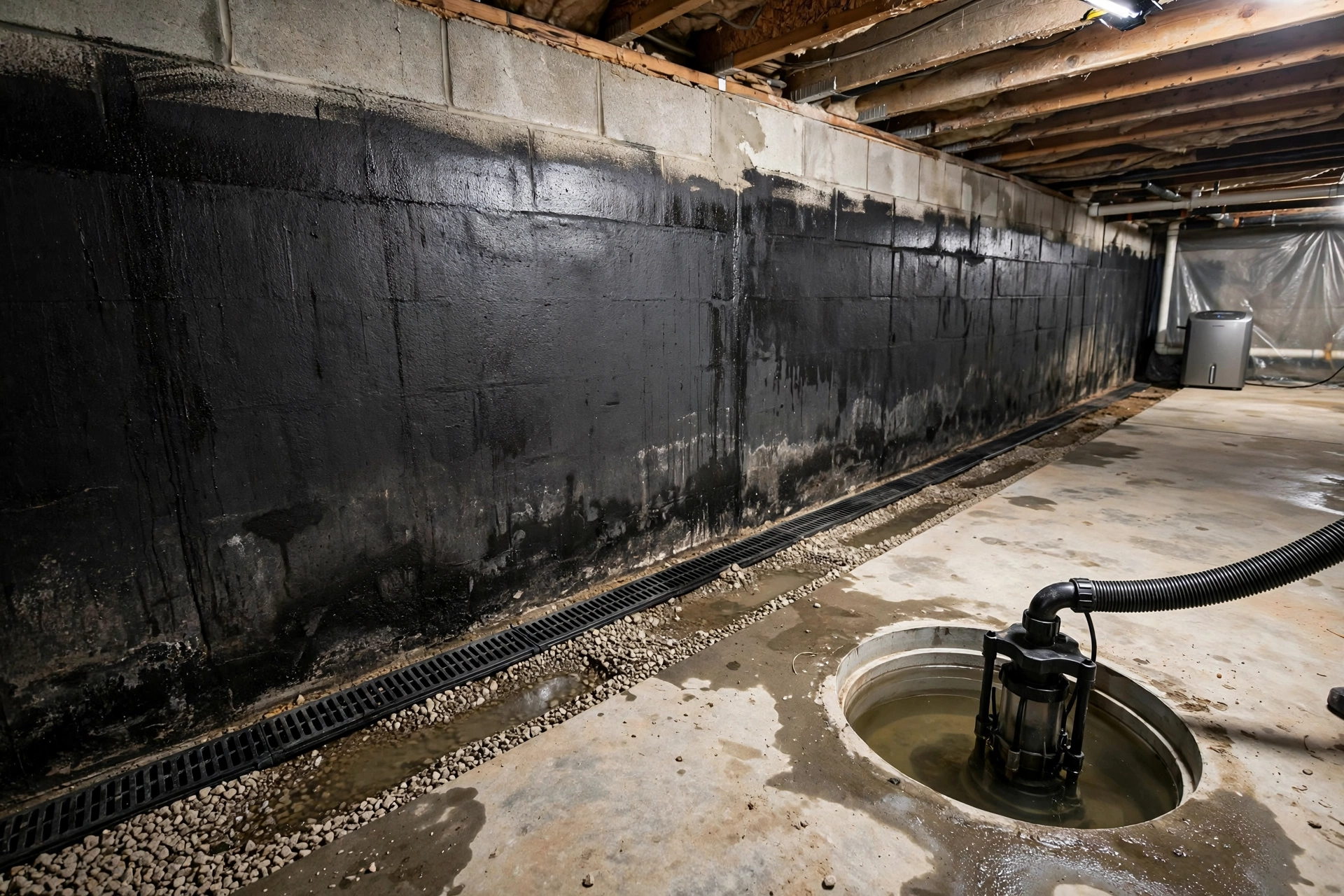
For most homes with persistent groundwater, an interior perimeter drain is the most reliable answer. A trench is cut into the floor slab beside the footing, a perforated pipe is laid in washed gravel and wrapped in filter fabric, and the trench is re-concreted. The pipe sits low enough to catch water rising beneath the slab and entering at the cove joint, and carries it to a sump basin. In block walls, the bottom course is often drilled so water trapped in the hollow cores drains into the channel.
Because it works inside the house, it can be installed in any weather, does not disturb the garden, and keeps working even when the water table is higher than the floor. It does not stop water reaching the outside of the foundation, and it will not repair a damaged wall. What it does is control the water level beneath the slab so pressure never builds high enough to push water through the floor. That pressure relief is why interior drainage outperforms wall coatings here: coatings try to hold water back, while a drain removes the pressure behind it.
Sizing and Backing Up Your Sump Pump So It Never Quits During a Storm
A perimeter drain is only as good as its pump. The basin collects the water, and the pump lifts it out and discharges it away from the foundation, typically at least 20 feet out. A check valve stops pumped water flowing back into the basin each time the pump stops, which otherwise causes short-cycling and early failure. Size the pump to the inflow: a typical home often uses a 1/3 horsepower submersible pump, while larger basements or heavy inflow may need 1/2 horsepower.
- Fit a battery backup pump. Power cuts often arrive with the same storms that cause the worst inflow.
- Add a high-water alarm, ideally one that alerts your phone, so a failed pump or blocked discharge is caught before water reaches the floor.
- Protect the discharge line from freezing by burying it below frost depth where possible and keeping the outlet clear of snow and ice.
- Test twice a year: pour water into the basin, confirm the pump starts, and check the discharge outside.
Interior Versus Exterior Drainage for a High Water Table at a Glance
Choosing between interior and exterior work comes down to access, budget, and severity.
Basement Drainage Slip-Ups That Leave the Water Table Winning
Most failed drainage jobs fail for a handful of predictable reasons. Painting the inside wall with a waterproof coating is the most common: it looks dry for a season, then blisters and peels as pressure pushes water through from behind, and it can hide worsening cracks. Another frequent mistake is discharging the sump pump too close to the house, which recycles the same water back into the soil and keeps the pump running forever. Other slip-ups include drains laid without filter fabric, which clog within a few years; a basin set too shallow; and no backup power.
What Better Basement Drainage Costs, and Where the Money Goes
Costs vary with basement size, wall material, access, and labour rates, so treat these figures as broad estimates, not quotes. Get two or three written quotes for the same scope. The cheapest quote is not always the cheapest job: a system without filter fabric, a sealed basin, or backup power may cost less on day one and far more the first time it fails.
When a Wet Basement Needs a Structural Engineer or a Waterproofing Contractor
Some wet basements are drainage jobs, and some are structural jobs wearing a drainage disguise. Bring in a structural engineer if you see horizontal cracks, stair-step cracking in block walls, a wall leaning or bowing inward, a heaved floor slab, or sticking doors and windows upstairs alongside the damp. These can indicate soil pressure moving the foundation, and drainage work should follow, not precede, the structural repair.
A specialist waterproofing contractor is the right call when water keeps returning despite surface fixes, when the water table is known to be high, or when the basement is to be finished and must stay dry. Choose one who diagnoses before quoting and specifies the pump, backup, and discharge route. Be wary of any pitch promising a permanently dry basement from a wall coating alone: against steady hydrostatic pressure, that promise rarely survives the next wet season.
Basement Groundwater Drainage Questions Homeowners Keep Asking
Can a basement ever be fully dry when the water table is high?
Yes, in practical terms. You cannot lower the water table under the whole neighbourhood, but a well-designed system keeps the water level around your footing below the floor slab and removes water faster than it arrives. Success means a dry floor through a full wet season.
Why does my basement leak even when it has not rained for weeks?
Because groundwater moves slowly. Clay soils stay saturated for weeks after rain, springs feed water continuously, and a high water table does not drop just because the sky is clear. Dry-weather seepage is a strong sign the source is below ground.
Is an interior drain enough, or do I need exterior waterproofing too?
For most high-water-table homes, an interior drain with a good sump system is enough, and it is the usual recommendation where exterior access is blocked or budgets are limited. Exterior waterproofing adds protection by stopping water before it reaches the wall.
How long does an interior perimeter drain last?
The pipe and channel can last decades when laid in gravel, wrapped in filter fabric, and kept free of silt. The pump is typically replaced every 7 to 10 years, and the battery backup needs testing and periodic replacement.
Will a sump pump run up my electricity bill or wear out from constant use?
A correctly sized pump in a well-drained system runs intermittently and uses modest electricity, roughly comparable to a small household appliance over a year. Constant running usually signals another problem, such as surface water feeding the soil or a discharge looping back to the house.
Should I finish my basement before or after fixing the drainage?
After, and only after the basement has stayed dry through a full wet season. Finishing first hides leaks behind walls, traps moisture in framing, and turns a manageable drainage job into a demolition job. Once drainage is proven, use moisture-resistant materials and keep access points reachable.
Does improving basement drainage help with mould and musty smells?
Yes, because persistent damp is what allows mould to grow on stored items, timber, and dust. Drainage removes the liquid water source, and a dehumidifier then deals with residual humidity. If mould already covers a large area, have it assessed professionally rather than painting over it.
Final Word: A Dry Basement Starts Below the Slab, Not on the Wall
Persistent groundwater cannot be painted over or stopped by sealing one crack at a time. It has to be given somewhere to go. Start at the surface with gutters, downspouts, and grading, intercept what you can outside, and then relieve the pressure beneath the slab with an interior drain and a sump pump that keeps working when the power fails. Done in that order, the work turns a basement that floods every wet season into usable space. If yours has stayed wet through more than one season, the next step is a proper diagnosis, not another coat of sealant.